ISLAMABAD: The federal government is considering granting a temporary exemption to major state-owned energy companies from key International Financial Reporting Standards (IFRS), a move aimed at preventing an estimated Rs400–500 billion in expected credit losses linked to the unresolved circular debt crisis.
A special committee has recommended that the Cabinet Committee on State-Owned Enterprises (CCoSOE) grant a five-year exemption from the implementation of IFRS 9 and IFRS 14 by relaxing provisions of the State-Owned Enterprises (SOEs) Act 2023 and the associated SOE policy. The Act had provided a three-year transition period, which expired in February 2026.
However, the proposal has been opposed by the Central Monitoring Unit (CMU) of the Ministry of Finance, which argues that such an exemption would undermine transparency and conceal the true fiscal risks facing state-owned enterprises.
According to the CMU, exemptions from IFRS 9 and IFRS 14 are inconsistent with the reform objectives of the SOEs Act 2023. The unit stressed that proper implementation of the accounting standards is essential, particularly for Sui Northern Gas Pipelines Limited and Sui Southern Gas Company Limited, to ensure transparent reporting of tariff differentials, regulatory deferral accounts, and recoverable receivables.
Government sources said a decision has, in principle, been made to provide relief to energy sector companies because full implementation of IFRS would require them to recognise expected credit losses arising from long-outstanding circular debt receivables, significantly weakening their balance sheets.
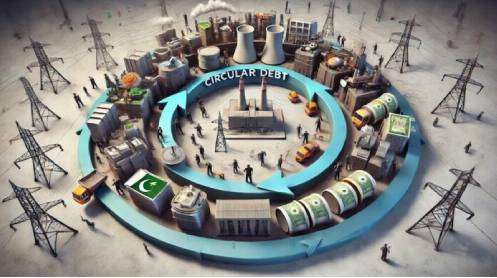
The gas sector’s circular debt has now exceeded Rs3.4 trillion, including around Rs1.8 trillion in principal liabilities. The government intends to settle approximately Rs1.5 trillion of this amount, although the plan is still awaiting approval from the International Monetary Fund.
The IMF has reportedly advised Pakistan to finance part of the settlement through bond issuances instead of raising Rs850 billion via dividends from Oil and Gas Development Company Limited, Pakistan Petroleum Limited, and Government Holdings (Private) Limited.
Petroleum Minister Ali Pervaiz Malik said the receivables are owed by the government through the Sui gas companies and assured that these obligations would eventually be settled.
“These receivables are due from the Sui companies and the government has assured that these dues will be settled in due course. That is why the exemption from IFRS applicability has been sought,” the minister said.
The proposed exemption would apply to SNGPL, SSGC, Pakistan State Oil, OGDCL, PPL, and GHPL, all of which carry substantial receivables linked to circular debt. Officials estimate that immediate compliance with IFRS would force these companies to make impairment provisions of Rs400–500 billion, significantly eroding their equity and market capitalisation.
Under IFRS 9, companies are required to recognise expected credit losses on financial assets, while IFRS 14 governs the accounting treatment of regulatory deferral account balances.
The special committee argued that, given the structural nature of Pakistan’s circular debt problem and the time required to implement the Gas Sector Circular Debt Management Plan (CDMP), a temporary exemption is justified. It also noted that the federal government has the authority to direct the Securities and Exchange Commission of Pakistan to grant exemptions on a case-by-case basis.
The committee further recommended retaining the current exemption from the Expected Credit Loss model under IFRS 9 for government-related receivables until the circular debt issue is substantially resolved.
In contrast, the CMU maintained that financial impairment resulting from IFRS adoption is not a sufficient justification for delaying compliance. It argued that companies should instead recognise and disclose the financial impact in their statements while continuing to comply with international accounting standards.
The finance ministry unit suggested that, if any relief is granted, it should be limited to no more than two years, with companies simultaneously preparing their financial statements in accordance with IFRS to ensure a smooth transition toward full compliance.
Story by Shahbaz Rana